

How a Sexual Assault Lawyer in Toronto Challenges Delayed Complaints and Historical Allegations
Few criminal cases are as difficult to defend as those built on allegations that surface twenty, thirty, or even forty years after the fact. Canada has no limitation period for sexual offences, which means a complaint made in 2026 about conduct alleged to have occurred in 1985 can proceed to trial like any other charge. Yet the passage of time changes everything about how such a case can be tested. A sexual assault lawyer in Toronto handling a historical allegation works with degraded evidence, vanished witnesses, and memories reconstructed over decades, and the defence strategy has to account for all of it.
The courts have consistently warned against equating delayed disclosure with fabrication. The Supreme Court has overturned the conventional notion that a real complainant complains soon and trial judges are now told that delay alone is not indicative of veracity. This is settled law and defence lawyers who challenge delay as inherently suspect will find the room swiftly.
The true debate is something else. Delay does not mean that a complainant is not to be believed, but it does mean that the credibility of the full evidentiary record should be examined. Memory’s not a tape. It degrades, takes on suggestion, and re-moulds itself around later experiences, therapy, family talk and media attention. A witness may be utterly truthful, and nonetheless mistaken about dates, sequences, places, and who was there. In a historical case, the main thing is to separate sincerity from accuracy.
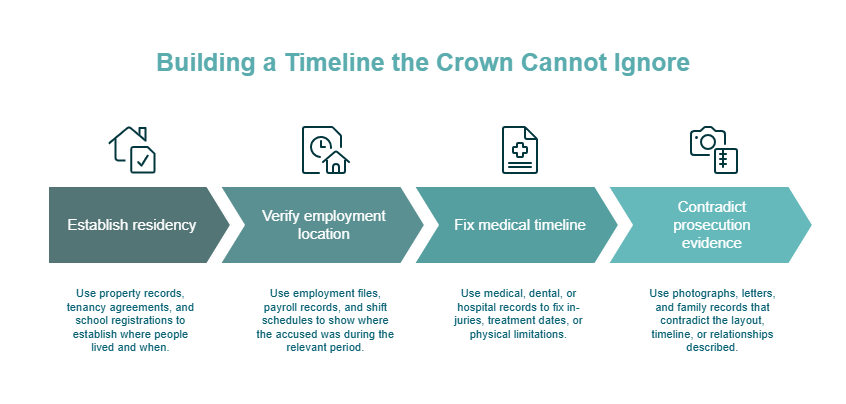
Building a Timeline the Crown Cannot Ignore
Effective defence work in these files begins with reconstruction. Counsel and investigators attempt to rebuild the world as it existed at the time of the alleged offence, often from fragments:
• Property records, tenancy agreements, and school registrations establishing where people actually lived and when
• Employment files, payroll records, and shift schedules showing where the accused was during the relevant period
• Medical, dental, or hospital records that fix injuries, treatment dates, or physical limitations
• Photographs, letters, and family records that contradict the layout, timeline, or relationships described
A single documented fact can unsettle an entire narrative. If a complainant describes an assault in a basement bedroom and the property records show the house had no basement until a renovation completed years later, the inconsistency is not a quibble. It goes to whether the memory is a reliable account of a real event or a reconstruction assembled after the fact.
Cross-Examination Within the Statutory Limits
Historical cases are also governed by strict procedural rules that constrain what defence counsel may ask. Section 276 of the Criminal Code restricts evidence of a complainant’s other sexual activity, and the section 278 regime governs access to therapeutic, counselling, and medical records. Applications under both provisions require written notice, a specific evidentiary foundation, and a hearing before the trial judge.
These applications are of great significance in cases of delayed disclosure, for it is often the manner in which a memory surfaced that is the most contentious point at trial. Timing of disclosure matters for reliability when a complaint arose during therapy, or after speaking with a relative, or in the setting of civil litigation. The counsel must frame the application correctly and argue the constitutional balance carefully, as a poorly framed request will simply be refused.
Lost Evidence and Section 11(b) Considerations
Where the passage of time has destroyed evidence that would have been available at the time, defence counsel can raise abuse of process or seek a stay, though the threshold is demanding. The accused must show more than theoretical prejudice. Courts want to know what specific evidence is gone, why it mattered, and how its absence prevents a fair trial. A destroyed employment record establishing an alibi, a deceased witness who was present throughout the relevant period, or demolished premises that would have contradicted the physical description of the scene are the sorts of concrete losses that carry weight.
Separately, delay between charge and trial engages section 11(b) of the Charter and the Jordan framework. That clock starts at charge, not at the alleged offence, but in complex historical files with multiple counts and disclosure disputes, ceiling breaches do occur and should be tracked from the first appearance.
These claims are usually made years later, after a person has lived a perfectly ordinary life, by relatives or friends of long standing. Bail requirements can separate an accused from their family. The charge, not the conviction, has implications for employment and professional license. Lawyers who specialize in this area handle the collateral consequences and the litigation itself, and they prepare clients for a process that usually lasts well over a year.
A historical allegation is not a case that cannot be won. Nor is it a case that is self-defending. It requires early investigative effort, disciplined use of the section 276 and 278 processes and a cross-examination based on documented fact rather than on assumptions as to how complainants ought to behave. If you are facing charges arising from alleged events that occurred years or decades ago, the single most important step you can take is to engage an experienced sexual assault lawyer in Toronto before you talk to the police, because the work of reconstruction which decides these cases is far easier to do early than late.

Comments are closed.